
Shiatsu - Acupressure - Massage - Reiki
Tom Swiss, Dipl. ABT, AOBTA CP, LMT
Hours by appointment
SAVE SHIATSU IN MARYLAND! Please take action against SB 370 / HB 374! And consider supporting HB 1527 to protect complementary and alternative care
New: "Vital Power Exercise", an eclectic Qi Gong, Shiatsu, and Meditation class on the second and fourth Fridays of each month, 5:30pm at the Catonsville Dojo.
What's all this "qi" stuff? Does it really work?
When you go to a physician, physical therapist, massage therapist, or other pracitioner operating in the model of modern Western medicine, he or she will talk to you about muscles, nerves, bones, and organs.
When you go to a shiatsu therapist, or an acupuncturist, he or she will talk to you about things like "Liver qi" and "Kidney yin".
What's the relationship between these concepts?
The analogy I like to use is that if you talk to a physicist about sound, you'll hear about pressure waves and frequency and vibrational nodes and anti-nodes; if you talk to a musician, you'll hear about intervals and scales and harmony. Different models, different ways of thinking, can be used to work with the same phenomena.
It is unfortunate that when some people encounter the theory of Chinese Medicine behind Asian Bodywork Therapy, they immediately dismiss ABT as incompatible with modern scientific knowledge. This is an error in two ways: it confuses the question of "Does it work?" with "How does it work?", and it misrepresents the nature of Chinese medical theory.
Does it really work?
Obviously I'm going to have a biased answer! As a practitioner, I've seen shiatsu and acupressure have wonderful effects on clients, and I have benefited greatly from these modalities myself (and from acupuncture as well).
But I also consider myself something of a skeptic, and I know that anecdotal
evidence is not reliable. So I'd like to present some of
the research evidence for the benefits of Asian Bodywork Therapy.
To date, most scientific research on Chinese medicine has focused on
acupuncture rather than ABT. However, some studies on shiatsu and acupressure
can be found by searching the National Library of Medicine (NLM)
PubMed
service. (NLM is part of the National Institutes of Health.) You can search
for articles on shiatsu and acupressure
by following this link.
(Since acupressure treatment of specific points tends to be more readily
standardized, most of these studies are of acupressure rather than of
shiatsu.)
Some specific interesting studies:
Some of the limitations of studies on Chinese medicine should also be noted.
For example, let's look at a study with negative findings. I haven't
found any negative findings for acupressure, but let's look at a study on
acupuncture for pain relief published in the Annals of Internal Medicine
(5 July 2005, Volume 143 Issue 1, Pages 10-19). This study found that
acupuncture was no better than "sham acupuncture" at relieving pain. However:
Unfortunately, fundamentally flawed studies like this are all too common.
The NCCAOM has started working more
closely with the NCCAM, and I hope to
see more and better research forthcoming. Meanwhile, it seems safe to conclude
that ABT is a safe treatment that has, at a bare minimum, positive non-specific effects in relieving stress and
chronic muscle tension, and that there is significant evidence of more
specific benefits.
When evaluating the research into complementary medicine in
general, I recommend considering this article by
Ted Kaptchuk.
(I also recommend his book The Web That Has No Weaver for those who
would like to learn more about Chinese medicine.)
From a physiological perspective, there are several theories about the meridians and points of
acupressure. One involves nerve reflexes between the skin and the visceral organs; there are others
involving the electrical properties of fascia (connective tissue), and another
involving embryological connections throughout the body that persist into adulthood.
It's possible that different points work by different mechanisms. The
explanation is far from complete. Certainly the "placebo effect" plays a
role - as it does in any treatment. (Google for "placebo
surgery", it's fascinating.)
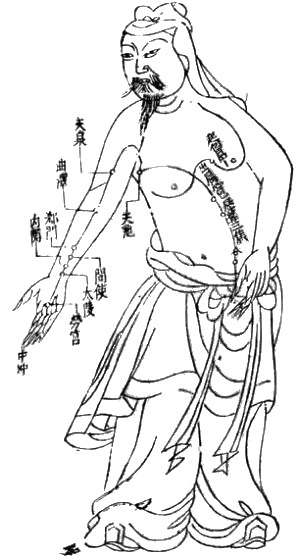
But Chinese medicine gives us a model of the human being that is not much
concerned with these anatomical and physiological explanations. This model is a
functional, not a structural, one; the Vital Substances, the Zang-Fu organs,
and the meridians are best understood by what they do, not by chopping
people up looking for structures.
The anatomical/reductionist model of the human being and the Chinese
medical model are complementary, not opposed to each other. The relationship
between the models is similar to two very different ways we can talk about
music. We might describe a certain sound in terms of a time-varying frequency
spectrum, or we might say something like "that's an A chord played on a
steel-string guitar". The former description may tell you why, when you
play it through your amp, it makes your speaker buzz because of some
resonance; the latter tells you how it works in the music.
Both models are correct, but emphasize different aspects of our
experience.
Understood in this way, qi is not something that is found in an anatomical
structure or physiochemical property of the body, but is something that is
experienced. It is not something mystical or mysterious; if you get up in the
morning and say "I feel full of energy today!", you have just made an
observation about qi.
"O genki desu ka?" is the Japanese way of asking
"How are you?"; it can be literally translated as "How is your ki (qi)?"
(Specifically, "genki" refers to what the Chinese call "yuan"
or "original" qi, a specific type related to your basic constitution.)
The question doesn't require any objective measurement to answer.
Indeed, can you imagine saying "I have a lot of energy today," only to
have a scientist perform a set of measurements and inform you that the total
amount of chemical and electrical energy in your body is in fact less than it
was yesterday, and so your statement is incorrect?
Obviously, the word "energy" is being used with two different meanings
here. When we talk about the energy of qi, we do not necessarily mean the
same thing that physicists mean when they speak of energy; the energy of qi
is a subjective and experiential phenomenon, not a completely objective one.
(Many other words are used in specialized senses in scientific discussion:
the physicist's definition of "work" is such that a weightlifter who returns
the bar to its starting point after a set has done no work on the weight,
despite what his or her aching muscles say. Similarly, mathematicians who
specialize in the field of "information theory" will say that a page full
of random letters has more information than a page of meaningful English text.)
Now, take thousands of years of careful observation of this experience
of energy and vitality; consider what physical and mental actions, what foods
and herbs, what lifestyle choices, and what therapies tend to cultivate it.
That's Chinese medicine.
Nationally certified by the National Certification Commission for Acupuncture
and Oriental Medicine. Certified Practitioner, American Organization for Bodywork
Therapies of Asia. State of Maryland Licensed Massage Therapist.
Contact Tom Swiss today to schedule your shiatsu or massage session!
How does it work?
So what is this "qi" stuff?
 Facebook
  Instagram